How the growth of commercial space created new paths for innovation, investment, and services, while changing how government and private industry work together to build the space economy.
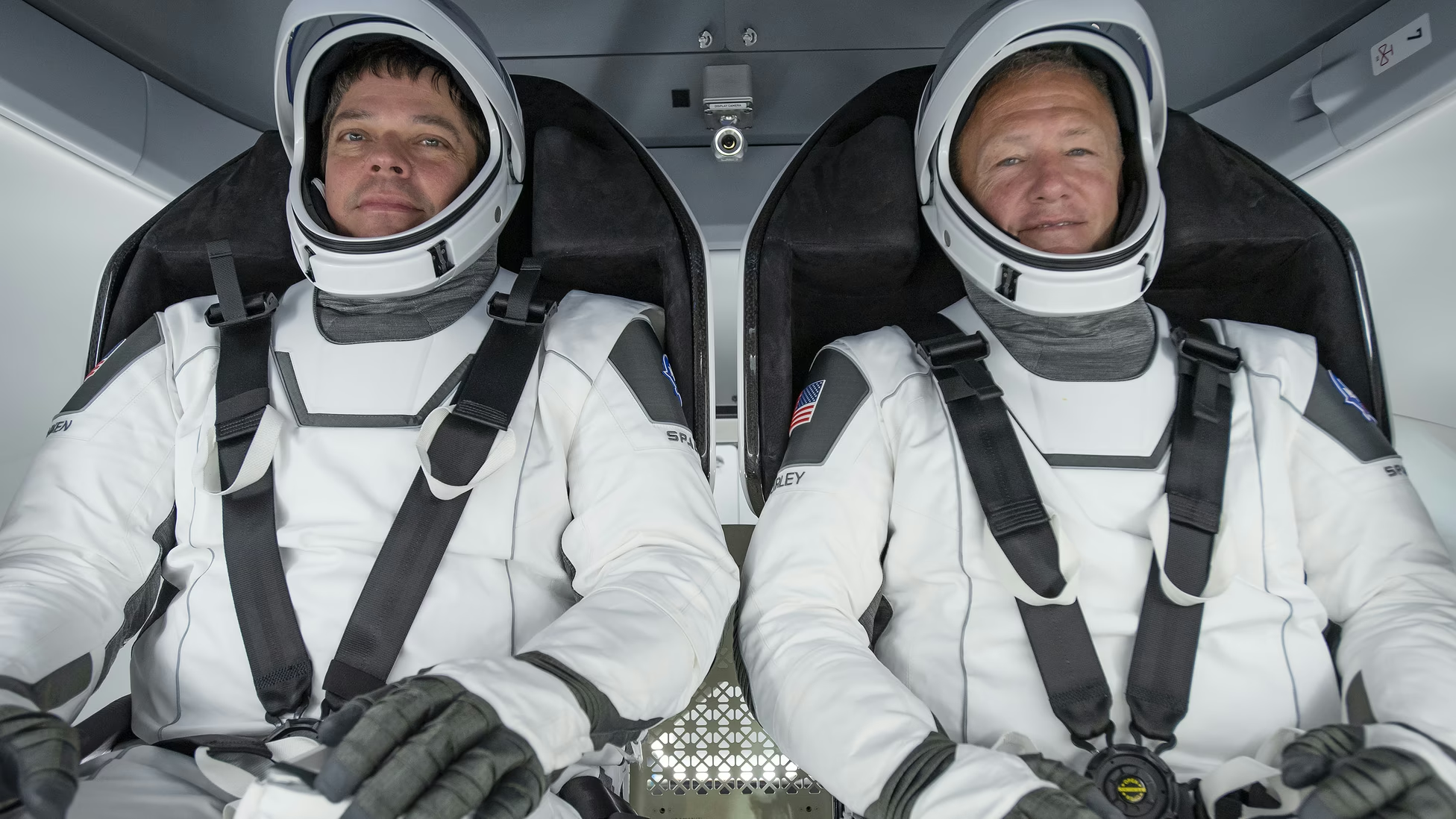
NASA astronauts aboard SpaceX’s Crew Dragon during the Commercial Crew era. Credit: NASA/SpaceX.
For much of the history of spaceflight, governments decided what would be built, what missions would be funded, and which goals were important enough to pursue. That model gave us extraordinary things, from Apollo to the International Space Station, but it also meant that many of the possibilities in space were tied to government budgets, national priorities, and political decisions.
Commercial space did not replace that system. It added another one alongside it.
This is what makes the last two decades of spaceflight so exciting to me. There are now more companies, more sources of investment, more customers, and more people capable of deciding that an idea is worth pursuing. At the same time, much of that commercial growth was made possible because NASA and other government agencies deliberately created opportunities for private industry to develop.
The result is not really a story about government giving way to business. It is about what becomes possible when both are contributing to the same industry in different ways.
The Shift to Commercial Space

Space Shuttle launch during NASA’s Shuttle program, which operated from 1981 to 2011. Credit: NASA.
The Shuttle flew from 1981 to 2011 and was a huge technical achievement, but it never achieved the frequent, inexpensive, routine access to space that had originally been envisioned. It remained costly to operate, required extensive work between flights, and suffered two fatal accidents. When the program ended in 2011, the United States no longer had its own way to carry astronauts into orbit.
For nearly nine years, American astronauts traveled to and from the International Space Station aboard Russia’s Soyuz spacecraft. This required astronauts to train in Russia, learn their space systems, and even speak Russian. NASA shifted to depending on another country for available seats, launch schedules, and continued crew transportation. The cost was also very high, eventually exceeding $80 million per astronaut flown, compared with an estimated average of about $55 million per seat for SpaceX’s Crew Dragon. Crew Dragon also restored launches from U.S. soil using a much newer spacecraft and launch system.
Around this time, NASA started pursuing a different vision for the future of U.S. spaceflight. In 2006, it created Commercial Orbital Transportation Services (COTS). Instead of designing another government-owned transportation system and paying contractors to build it to NASA’s specifications, NASA offered funding and technical support to companies developing transportation systems of their own. Payments were tied to milestones, companies were expected to contribute private money, and NASA intended to eventually purchase transportation from successful providers rather than own the vehicles itself.
SpaceX was one of the first companies selected, receiving a development agreement worth $278 million in 2006 that ultimately grew as additional milestones were added. NASA provided money, expertise, access, and a customer with a very real need, while SpaceX was responsible for developing its own Falcon 9 rocket and Dragon spacecraft and bringing private investment into the effort. The government was not just buying a spacecraft. It was helping create a company-owned capability that could eventually serve NASA and customers beyond NASA.
By 2008, NASA was ready to move from helping companies develop cargo transportation to buying the service itself. Commercial Resupply Services contracts were awarded to SpaceX and Orbital Sciences for deliveries to the International Space Station (ISS), replacing work that had previously depended heavily on the Shuttle. NASA then pursued the same basic idea for astronauts through Commercial Crew. In 2020, SpaceX’s Crew Dragon began launching from American soil, ending the nearly nine-year gap.
Companies still had to decide whether those opportunities fit the businesses they wanted to build. Blue Origin, for example, participated in NASA’s early Commercial Crew development but chose not to compete for the next major funded development phase in 2012, instead continuing its work with NASA under an unfunded agreement. SpaceX continued aggressively through the government-funded program.
More Players, More Innovation

Planet Dove satellites deployed from the International Space Station. Credit: NASA.
What interests me most about this transition is not simply that private companies now build rockets. It is that adding more participants changes what ideas have a realistic chance of becoming something.
NASA can pursue missions because they advance science, exploration, national capabilities, or other public goals, whether or not those missions could ever support a profitable business. Commercial companies have different incentives and limitations, but they can also decide to pursue something because they believe there is a customer, a future market, or simply a better way of solving an existing problem.
Reusability shows how different approaches can emerge around the same goal. The Space Shuttle was partially reusable but required a large amount of work between flights. SpaceX’s Falcon 9 took a different approach by routinely recovering and reflying its first stage while treating the upper stage as expendable. Stoke Space is pushing the idea in another direction with Nova, which is being developed to make both stages reusable.
Innovation can be a new technology, but it can also be a different design, a cheaper process, a new business model, or an application that nobody had prioritized before. Having different companies, researchers, investors, and teams working in the same industry means different backgrounds, expertise, assumptions, and priorities are being brought to those problems. Some ideas will fail. Others may create capabilities that were never part of a government plan.
Planet is another good example. Rather than following the traditional model of a relatively small number of large Earth-observation satellites, Planet built large constellations of small satellites designed to image Earth repeatedly and at high frequency. NASA did not commission Planet to create that model. The company developed the capability commercially, and in 2018 NASA began purchasing Planet and other commercial satellite data to evaluate how it could supplement observations from NASA’s own Earth-science missions.
Orbital debris presents an almost opposite example. NASA has studied the debris problem for decades, and by 2005 its own modeling showed that simply preventing new debris would eventually be insufficient because collisions among objects already in orbit could continue increasing the debris population. Yet recognizing that objects should be removed and establishing an operational debris-removal capability are very different things.
Today, companies such as Astroscale are trying to make active debris removal and end-of-life servicing into services that governments and satellite operators can purchase. NASA’s current assessments also discuss commercial active-debris-removal and spacecraft-reentry services as an emerging part of the industry. Government research helped establish the problem and develop important technologies, while commercial companies are testing whether solving that problem can become an operational service.
From Transportation to a Much Bigger Industry

Firefly Aerospace’s Blue Ghost lunar lander, developed as part of NASA’s Commercial Lunar Payload Services initiative. Credit: Firefly Aerospace.
The commercial model that NASA tested with cargo did not stay confined to transportation. In 2018, NASA established Commercial Lunar Payload Services (CLPS), allowing the agency to purchase rides for scientific instruments and other payloads aboard commercially operated lunar landers instead of developing every robotic lunar delivery system itself. The companies can sell the same basic capability to other customers, giving a spacecraft developed partly around NASA demand the possibility of serving a broader lunar market.
NASA is now trying something similar with space stations. In 2020, it selected Axiom Space to develop a commercial module for the ISS, and it has since supported several companies developing independent commercial stations. This allows NASA to spend more of its resources on exploration, science, and missions that may never make sense as businesses instead of owning every transportation vehicle, station, or delivery system it needs. Commercial companies gain a major early customer while still having the opportunity to find other uses and customers for what they build.
However, NASA contracts are still extremely important to many companies, and government budgets can determine whether entire markets develop at all. Regulation affects what companies can launch and operate, policies determine how agencies can work with them, and changes in administrations and congressional priorities can redirect programs. Private investment creates another path, but investors and customers introduce pressures of their own. Government can take on scientific and public-interest missions that a market might never support. Companies can pursue ideas that have never been selected as national priorities.
For me, that is where the excitement of commercial space really is. It is not simply that there are more rockets launching or more companies with space in their name. There are more paths for an idea to become real. A problem like orbital debris can become something a company builds a service around. A different approach to Earth observation can become useful enough that NASA decides to buy the data. Several companies can pursue completely different versions of reusable launch vehicles, lunar landers, or space stations rather than waiting for one design to be chosen for everyone.
Space is still expensive, difficult, political, and heavily influenced by governments. Plenty of commercial ideas will fail. But the range of people and organizations capable of influencing what gets built has expanded significantly, and with it, so has the range of things we can try to do in space. Government helped create many of those opportunities; commercial companies are taking them in directions government could not have planned in advance, and each is increasingly shaping what the other can do next.
This relationship is still evolving, which may be the most exciting part. We are not looking at a finished commercial space economy. We are watching more ideas, technologies, markets, and ways of participating emerge while the rules and institutions around them are still being worked out. What survives that process will shape not just who goes to space, but what we decide space can be used for in the first place.
Sources and Further Reading
NASA
Commercial Orbital Transportation Services: A New Era in Spaceflight
Management of Crew Transportation to the International Space Station
Commercial Small-Sat Earth Data for Science
Commercial Lunar Payload Services
Weinzierl, M., & Rosseau, B. (2025). Space to Grow: Unlocking the Final Economic Frontier. Harvard Business Review Press.