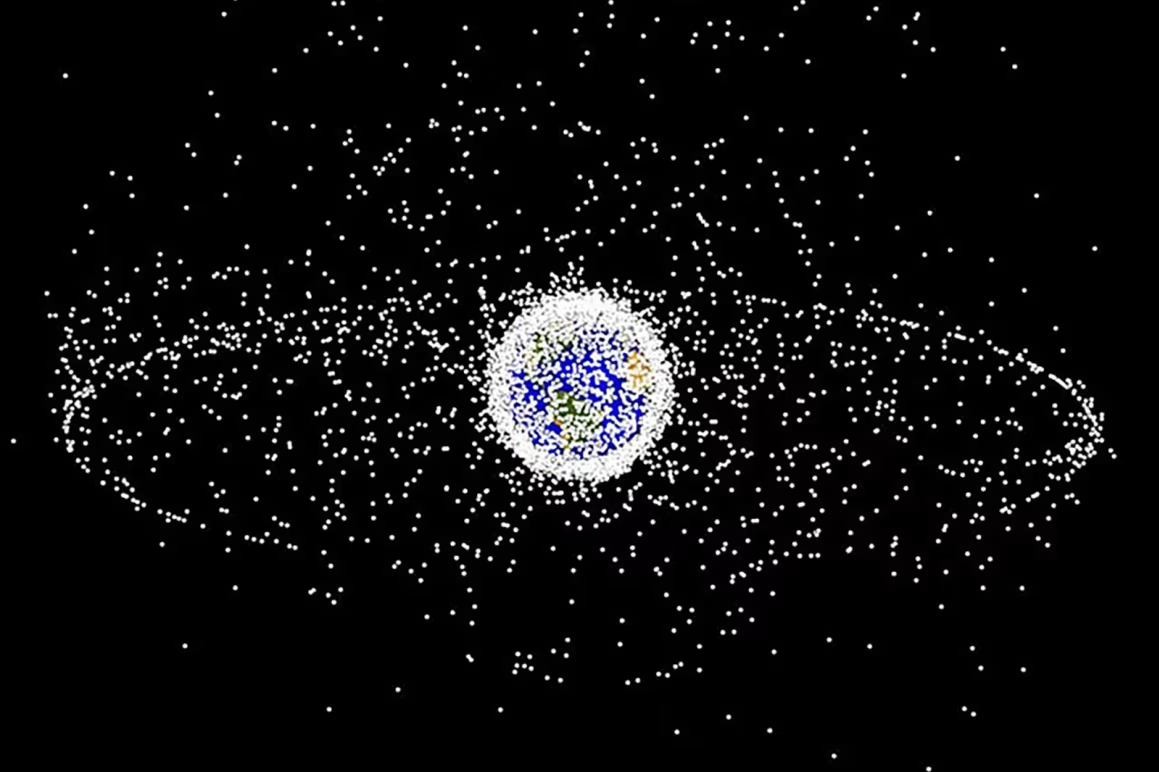
Orbital debris in Earth orbit. Credit: NASA. Orbital Debris Program Office (ODPO)
Launch Signal is an independent platform exploring humanity’s evolving relationship with space. Through research, analysis, and interdisciplinary thinking, it examines the technologies, policies, commercial developments, and cultural perspectives shaping the future of space activity.
Space is shaped by far more than engineering alone. Technology, economics, policy, history, culture, and the ways people have understood the sky all continue to influence how humanity explores and builds beyond Earth. Launch Signal brings these perspectives together to better understand the systems shaping space today and where they may be headed tomorrow.
The Milky Way, by Infrared Astronomical Satellite (IRAS), 1983. Credit: NASA/JPL-Caltech
Research and writing exploring the technologies, policies, industries, histories, cultures,and ideas shaping humanity’s relationship with space.
-
For most of human history, the sky was an intimate and fundamental tool. Humans relied on celestial knowledge to navigate oceans, migrate across landscapes, grow food, mark time, and orient themselves within the world. The astronomical practices, celestial lore, mythologies, religions, and worldviews of ancient cultures are now studied through archaeoastronomy, a field sometimes described as the “anthropology of astronomy.”
How the growth of commercial space created new paths for innovation, investment, and services, while changing how government and private industry work together to build the space economy.
Why orbital debris is so difficult to manage, what decades of accumulation have taught us, and how new technologies are opening possibilities beyond disposal.
Commercial expansion, lunar development, resource extraction, national security, and new technologies are exposing gaps in a system of space governance that has changed far less than space itself.
An ongoing look at companies across launch, in-space services, and sustainability, what they’re building, how they operate, and what they signal about where space activity is going.
SCOPE is a framework for evaluating how the systems we build in space can remain useful, adaptable, and responsible over time. It is designed around continuity, where technical progress and long-term stewardship are treated as parts of the same system rather than competing priorities.
How Pacific wayfinding, archaeoastronomy, GPS, satellite observation, and maps beyond Earth reveal changing relationships between knowledge, technology, and the ways unfamiliar environments are understood.
Orbit can be a place to manufacture, test, and operate, but some of that value is realized only when materials or hardware return to Earth. Research, hardware recovery, manufacturing, and station operations can all depend on that return path, making downmass part of the larger logistics of orbital activity.
Currently Exploring
Which companies am I paying attention to right now?
Right now, I’m especially interested in companies working across orbital debris, in-space services, launch, and commercial infrastructure. You can see more of the companies I’m following here.
What have I been reading in my free time (outside of academic work)?
Please check out my Goodreads profile for my read, reading, and want-to-read lists.
What topics am I currently exploring beyond my primary research?
Archaeoastronomy, Polynesian and Austronesian wayfinding traditions related to the stars/space, space-related biographies (particularly women and people of color), astronaut accounts, cosmology, artificial intelligence, singularity theory, and cultural interpretations of the night sky.
SpacePunk Ari
M.S. Commercial Space Enterprise | B.S. in Space Studies (Aerospace Science) |A.S. in Aeronautics
My academic background spans aeronautics, space studies, commercial space, space policy, and unmanned systems. My experience includes NASA L’SPACE, mentorship through NASA L’SPACE workforce initiatives, and an internship with ASU SpaceWorks supporting hands-on hardware development and vacuum testing through a NASA Lucy mission-sponsored program.
I’ve always been drawn to the broader questions surrounding space, not just how we get there, but how people have understood, interpreted, and interacted with the sky throughout history. That curiosity continues to shape how I think about commercial space, exploration, stewardship, and humanity’s future beyond Earth.
Launch Signal brings these interests together in one place, exploring space not only as an engineering challenge, but also as a technological, cultural, historical, and human endeavor.